
In discussions about pregnancy and abortion in the United States and many parts of the world, the names “Plan A,” “Plan B” and “Plan C” are often heard.
- Plan A refers to regular contraception, such as condoms, pills or other long‑term methods of birth control.
- Plan B refers to emergency contraception (the “morning‑after pill”). It is taken after unprotected sex to prevent fertilization and cannot terminate an established pregnancy.
- Plan C usually means medication abortion. When someone asks “what is a plan c”, the answer is that it is a two‑step pharmaceutical method to end a pregnancy once fertilization has occurred. This approach uses mifepristone, developed in the 1980s, and misoprostol, discovered in 1988 for its miscarriage‑inducing effect.
What is Plan C and why is it called this?
“Plan C” is not the name of a specific drug; it is a social initiative and information hub that arose in the United States to help people learn about medication abortion amid abortion‑policy restrictions. The idea behind the name is: if contraception (Plan A) is not used or fails and emergency contraception (Plan B) is not taken or does not work, then searching for “what is a plan c” directs people to a third option—the use of medication to end a pregnancy. The U.S. organization Plan C reports that this two‑drug method is listed by the World Health Organization as an essential medicine and is used by millions of people worldwide each year.
Plan C refers to a combination of two drugs—mifepristone (the first step) and misoprostol (the second step). According to Plan C’s guide, mifepristone blocks the pregnancy‑supporting hormone progesterone so the embryo stops growing; then 24–48 hours later misoprostol induces uterine contractions to expel the pregnancy tissue.
The founders of Plan C state that this regimen, when used in the first trimester, is up to 98 % effective and serious complications are extremely rare; only slightly more than two patients per 1,000 experience major complications. A study of more than 300,000 patients in Canada in 2021 found no increase in complications after easing regulatory restrictions and concluded that mifepristone can be dispensed safely like other medications.
How does it work?
The following list summarizes the steps of “what is a plan c” according to mainstream medical organizations:
- First step – taking mifepristone: This tablet blocks progesterone and stops the embryo from growing. Cleveland Clinic notes that using mifepristone and misoprostol to complete an abortion is safe up to the first 12 weeks of pregnancy.
- Second step – taking misoprostol: Patients take misoprostol 24–48 hours after the first drug. It makes the uterus contract and pushes out the pregnancy tissue. A fact sheet from New York State’s health department explains that patients dissolve misoprostol between the gum and cheek or insert it vaginally, and it can cause strong cramping and bleeding.
Many people use Plan C medications at home, often under the guidance of telehealth or a doctor. However, determining gestational age is important; a medical exam, ultrasound or blood test can confirm how far along the pregnancy is. The FDA approves mifepristone and misoprostol up to 10 weeks, although some studies show effectiveness up to 12 weeks.
Comparing Plan C, Plan B and Plan A
| Aspect | Plan A (contraception) | Plan B (emergency contraceptive) | Plan C (medication abortion) |
|---|---|---|---|
| Purpose | Prevent fertilization | Prevent pregnancy after unprotected sex | End an existing pregnancy |
| Timing | Used regularly | Within 72 hours of intercourse[1] | Within 10–12 weeks from the first day of the last menstrual period[8] |
| Drugs/Ingredients | Various hormonal or non‑hormonal methods | Levonorgestrel (or ulipristal) | Mifepristone and misoprostol |
| Effect on pregnancy | Prevents fertilization | Prevents fertilization; does not cause abortion | Causes abortion after pregnancy has started |
| Effectiveness | High with correct use | 75–89 % effective[10] | 95–98 % effective[11] |
These table items are simplified; the report elaborates on the scientific details in the text.
Safety and side effects
Research and government health agencies report that medication abortion is generally safe and serious complications are rare. Key points from the cited studies include:
- Strong safety record: Since the FDA approved mifepristone in 2000, more than 4 million people in the U.S. have used it. And studies show severe complications are extremely rare[5].
- High efficacy: Data from Plan C and Hey Jane show that the combination of mifepristone and misoprostol is up to 98 % effective in the first 10 weeks[11], while misoprostol alone is 80–94 % effective.
- Common side effects: Bleeding, intense cramps, headache, nausea, diarrhea and fever are typical; these symptoms usually last from several hours to a few days[13]. The New York health department notes that heavy bleeding often occurs after misoprostol and may feel like a heavy period.
- Serious complications and warnings: According to the Parkville Women’s Clinic, urgent medical care is needed if you soak two or more pads per hour for two hours. A fever lasting more than 24 hours, notice foul‑smelling discharge, experience severe abdominal or back pain, or have a rapid heartbeat.
- Who should not use Plan C: Cleveland Clinic advises that people beyond 10 weeks of gestation, those allergic to mifepristone, with ectopic pregnancy, long‑term corticosteroid use, or bleeding disorders should avoid this method.
Laws and access
Access to medication abortion depends on national and state law. New York’s health department states that some U.S. states prohibit telehealth prescribing or require in‑person visits. In January 2023, the FDA ended the in-person pickup requirement for mifepristone. Allowing dispensing by local pharmacies or by mail[17]. According to Plan C’s guide, more than 65 % of U.S. abortions provided by clinicians or telehealth involve pills, and in states with bans pills account for up to 95 %[18][19]. Legal risks vary by state, so consulting legal helplines is important.
Cost and funding
The cost of medication abortion varies by country. In the U.S., Hey Jane reports that the average cost of Plan C is about $568 when obtained through a clinic or online service. Though some programs use sliding scales to lower the price. Plan C’s fact sheet notes that some activist networks and websites provide pills free or at low cost but offer no medical care or follow‑up, increasing legal and health risks.
Research and statistics
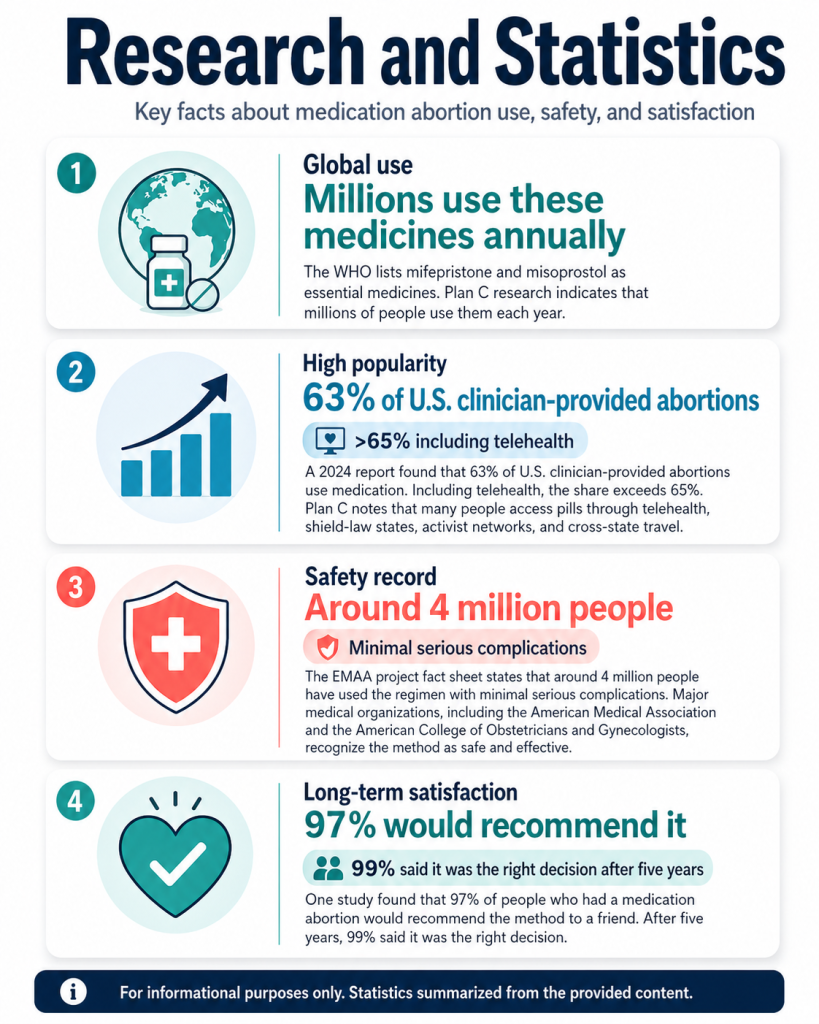
- Global use: The WHO lists these drugs as essential medicines, and Plan C’s research shows that millions of people use them annually.
- High popularity: A 2024 report found that 63 % of U.S. clinician‑provided abortions use medication; including telehealth, the share exceeds 65 %[18]. Plan C reports that many people access Plan C pills through online telehealth, shield‑law states, activist networks and cross‑state travel.
- Safety record: The EMAA project’s fact sheet states that around 4 million people have used the regimen with minimal serious complications; major medical organizations—including the American Medical Association and the American College of Obstetricians and Gynecologists—recognize the method as safe and effective.
- Long‑term satisfaction: One study found that 97 % of people who had a medication abortion would recommend the method to a friend, and after five years, 99 % said it was the right decision.
When to consult a health professional
Because the core purpose of “what is a plan C” inquiries is to gather information, it is essential to emphasize that you should have a health‑care professional evaluate you before starting the regimen. New York health authorities advise that if, after taking misoprostol. You pass clots larger than a lemon or soak more than two pads in an hour for two hours, and have severe abdominal/back pain. Prolonged fever or foul discharge, you should seek immediate medical attention[25]. People with ectopic pregnancies or hormone‑related disorders should not use mifepristone and misoprostol.
Conclusion
Overall, Plan C or medication abortion is a non‑surgical, drug‑based method of ending a pregnancy once it has begun. When someone asks “what is a plan c”, the answer is that it is a regimen of mifepristone and misoprostol used within the first 10–12 weeks of gestation that is safe and effective. Research shows success rates of 95–98 % and extremely low rates of serious complications. However, before deciding, individuals should consider their health and legal context and consult a physician. The social initiative Plan C aims to raise awareness about the safety, efficacy and accessibility of this method through credible information and research, but any abortion decision is personal and health‑dependent.