
Bleeding is a common sign after using abortion pills. Many people feel worried when bleeding starts. But in most cases, it is normal. When you take abortion pills, your body goes through changes. The uterus starts to clear. This process causes bleeding and cramps. The topic bleeding after taking abortion pills is very important to understand. It helps you know what is normal and what is not.
In this guide, we will explain everything in very simple words. We will talk about when bleeding starts, how long it lasts, and when you should get help.
This information is also shared for users of the website “abaration pills”, so people can understand their body better.
We will repeat the key topic bleeding after taking abortion pills to help you remember it clearly and understand it well.
What is bleeding after taking abortion pills?
Bleeding after taking abortion pills means your body is removing pregnancy tissue from the uterus. This is a normal process.
After taking the pills, the uterus starts to contract. This causes bleeding like a heavy period.
Some people may see clots. Some may see tissue. This is also normal in many cases.
On the website abaration pills, this is explained in a simple way so people do not panic.
The topic bleeding after taking abortion pills is not the same for everyone. Every body reacts in a different way.
Some people bleed more. Some people bleed less.
Both can be normal.
When does bleeding start?
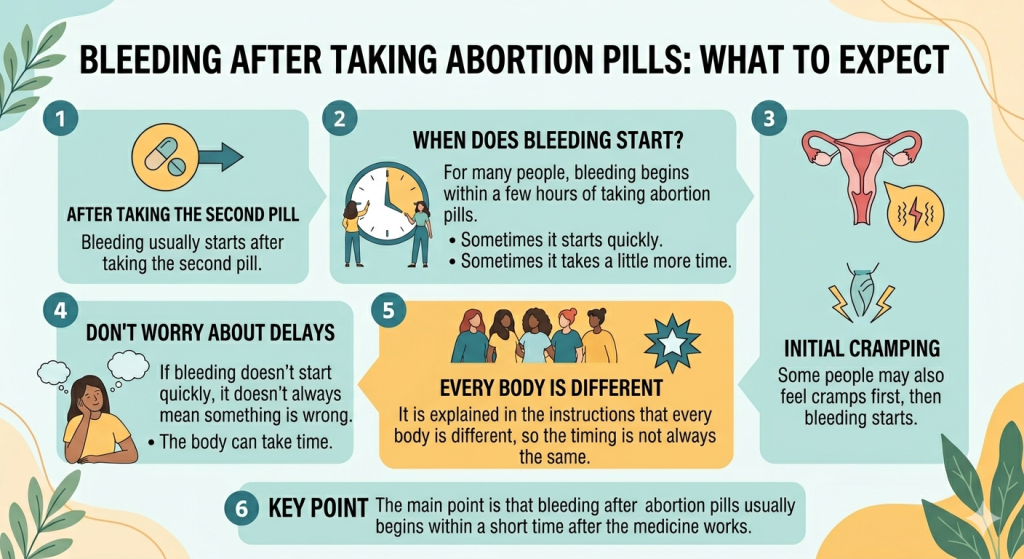
Bleeding usually starts after taking the second pill.
For many people, bleeding after taking abortion pills begins within a few hours.
Sometimes it starts fast. Sometimes it takes a little more time.
Some people may also feel cramps first, then bleeding starts.
If bleeding does not start quickly, it does not always mean something is wrong.
The body can take time.
On abaration pills, it is explained that every body is different, so timing is not always the same.
The main point is that bleeding after taking abortion pills usually begins within a short time after the medicine works.
How long does bleeding last?
Bleeding does not stop in one day for most people.
Bleeding after taking abortion pills can last from a few days to a few weeks.
For some people, light bleeding can continue for up to 4 to 6 weeks.
At first, bleeding can be heavy. Later it becomes light.
Then it slowly stops.
This is a normal recovery process.
The website abaration pills also explains that the body needs time to heal.
So, bleeding after taking abortion pills is not the same length for everyone.
Some stop early. Some take more time.
Both can be normal if there are no danger signs.
What is normal bleeding?
Normal bleeding after taking abortion pills can look like this:
- Heavy bleeding at first
- Blood clots
- Cramping in the stomach
- Flow like a strong period
- Light spotting later
Heavy bleeding is usually strongest in the first few hours.
Then it slowly becomes less.
Some people may pass small or medium clots. This is also normal.
On abaration pills, users are told that bleeding can look different for each person.
So do not compare too much with others.
What is not normal bleeding?
Sometimes bleeding can be a warning sign.
You should be careful if:
- Bleeding is very heavy for many hours
- You feel very weak or dizzy
- You have strong pain that does not stop
- There is bad smell from discharge
- You have fever
These signs are not normal.
In such cases, bleeding after taking abortion pills may need medical help.
The website abaration pills also says that safety is very important.
If anything feels wrong, it is better to talk to a doctor.
When should you see a doctor?

You should see a doctor if:
- Bleeding is too heavy
- Bleeding does not slow down
- You feel very sick
- You have strong pain for a long time
Doctors can check if everything is okay.
They may do a simple test or scan.
Bleeding after taking abortion pills should become lighter over time.
If it does not, medical help is important.
On abaration pills, users are advised not to ignore long or heavy bleeding.
Recovery after bleeding
After bleeding after taking abortion pills, the body starts healing.
The uterus becomes normal again.
Some light spotting may stay for a few days or weeks.
The next period usually comes after 4 to 8 weeks.
It may be heavier or lighter than normal.
This is also normal.
Your body is adjusting.
The topic bleeding after taking abortion pills is closely connected with recovery time.
When bleeding stops, healing continues inside the body.
Emotional changes
Some people feel tired or emotional after the process.
This is normal too.
Hormones in the body are changing.
Along with bleeding after taking abortion pills, mood changes can also happen.
You may feel:
- Sad
- Tired
- Calm after recovery
Talking to someone you trust can help.
The abaration pills website also reminds users that support is important during this time.
Tips for comfort
During bleeding after taking pills, you can take care of yourself in simple ways:
- Rest as much as possible
- Drink water
- Use clean pads
- Eat light food
- Avoid heavy work
These small steps help your body recover.
Do not rush your body.
Healing takes time.
Key things to remember
Here are simple points about bleeding after abortion pills:
- Bleeding is normal
- It can be heavy at first
- It slowly becomes light
- It can last days or weeks
- Every body is different
The website abaration pills explains these points in easy words so people understand better.
Final words
Bleeding after taking pills is a normal part of the process for many people.
It shows that the body is working and healing.
But you should always watch your symptoms.
If something feels wrong, do not ignore it.
Talk to a doctor for safety.
Remember, every body is different.
The website abaration pills also supports people by sharing simple and clear information.
Understanding bleeding after abortion pills helps reduce fear and gives more confidence during recovery.
Take care of your health and listen to your body.